
A Sea of Red: At the Source of Our Cranberries
Field notes from our long-standing cranberry cultivation partnership
Visit: 6 October 2026 · Heilongjiang, China
Across the fields, a year’s work gathers into red.
On 6 October 2026, the YOHOLIFE® team visited our long-standing cranberry cultivation partner in Heilongjiang, China. We came to follow a familiar ingredient back to a less familiar beginning: the plants close to the ground, the harvest moving through the fields, and the people bringing it in.
A tractor stands between lines of filled crates. Beyond them, the fields stretch towards low hills beneath a wide sky. According to our partner, the base covers 4,200 mu—approximately 280 hectares—and produces around 3,000 tonnes of cranberries annually. The scale is immediately visible; the work within it deserves a closer look.
This visit was part of a relationship built over time. Returning to the source helps us understand what each harvest requires, what an ingredient’s specification can tell us, and how the value created here can remain connected to the place and people behind it.
01 / THE PLANT
A North American beginning, rooted in China
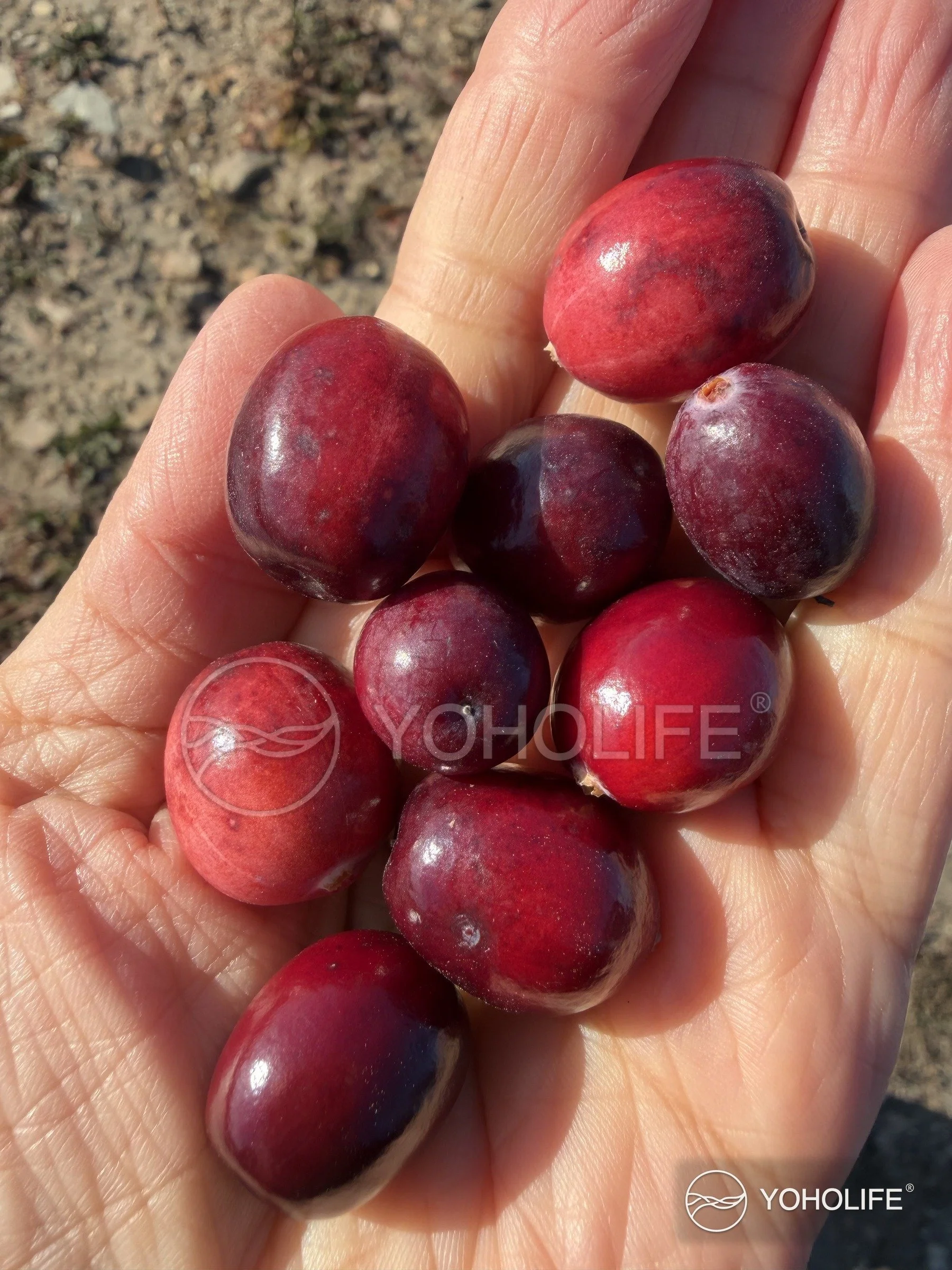
The large-fruited cranberry, Vaccinium macrocarpon Aiton, is a low-growing perennial evergreen vine native to North America. Its stems spread close to the ground; its berries become one of the most recognisable reds of the autumn harvest. It is cultivated in acidic growing conditions, with careful attention to soil and water management.1
Our partner tells us that the base’s original North American planting material came from Wisconsin, in the United States. That history gives this landscape another dimension: a botanical grown far from its original home, sustained through cultivated planting material and local agricultural knowledge.
The fruit carries more than its colour. Cranberries contain a range of naturally occurring plant compounds, including proanthocyanidins, or PACs. Their A-type PAC structures are a particular focus of cranberry research. For us, understanding these compounds begins with knowing the plant from which they come.
02 / TWO WAYS TO HARVEST
Red on the water, red in the field
The harvest photographs tell two different stories of the same fruit.
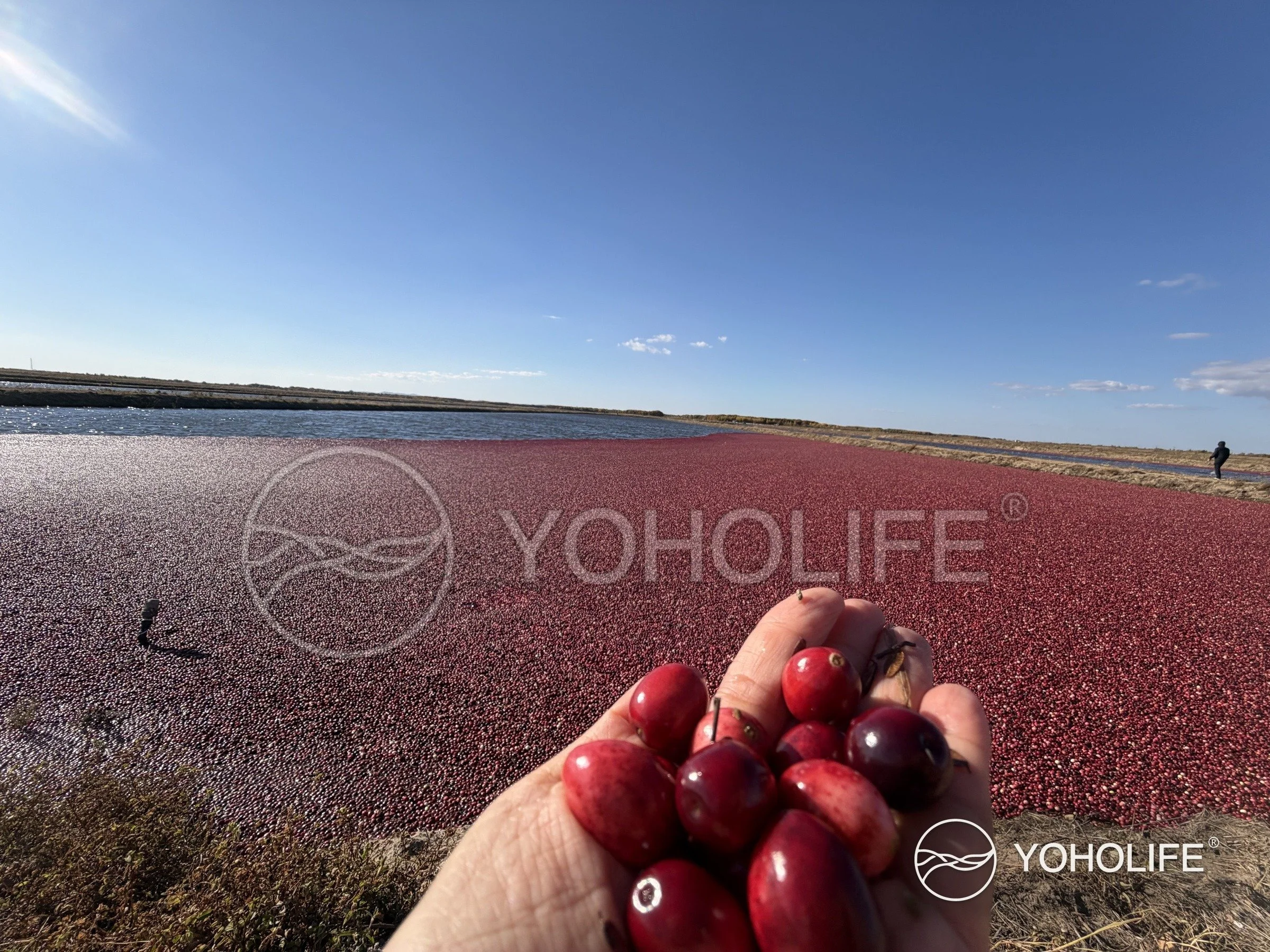
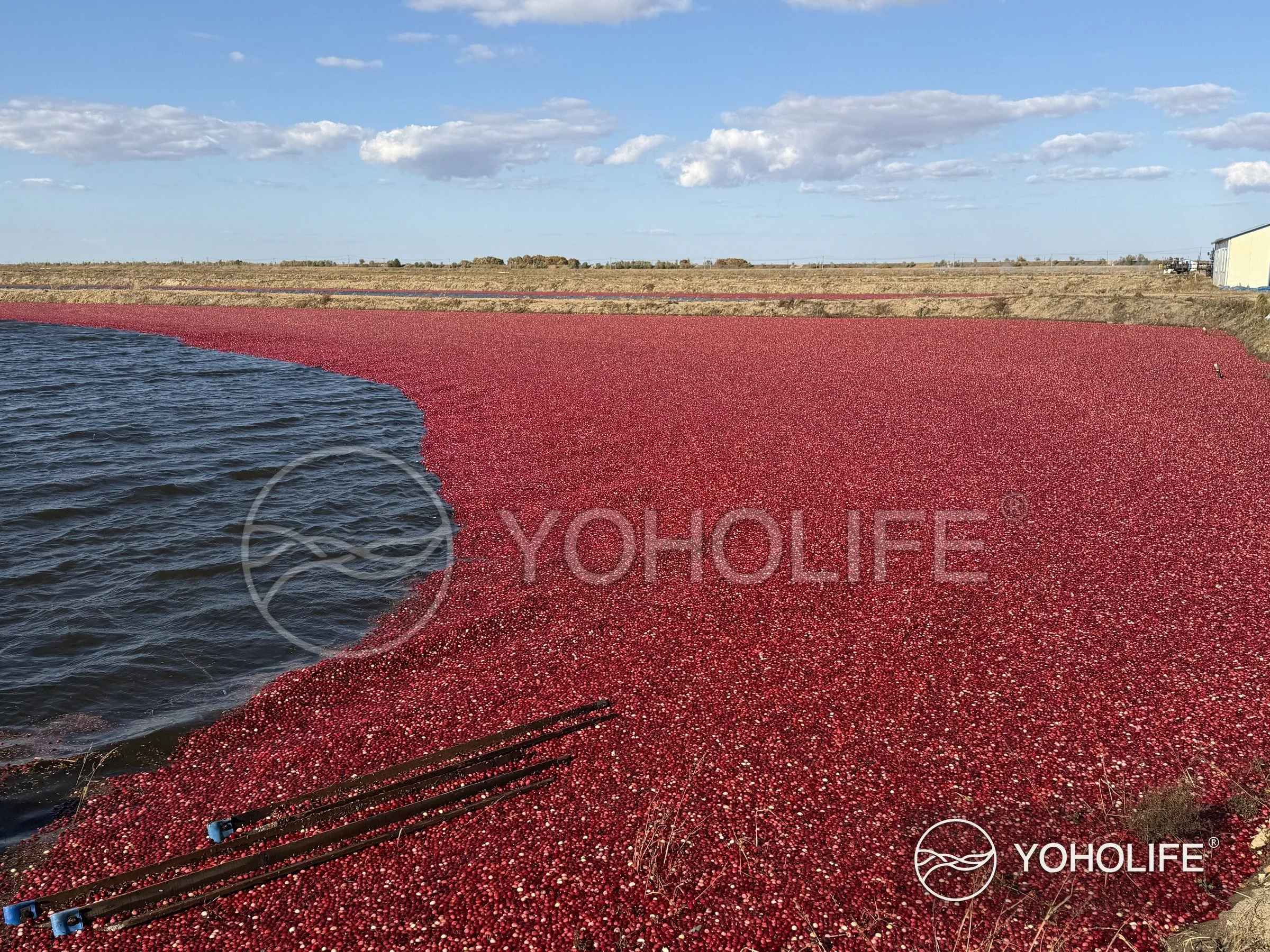
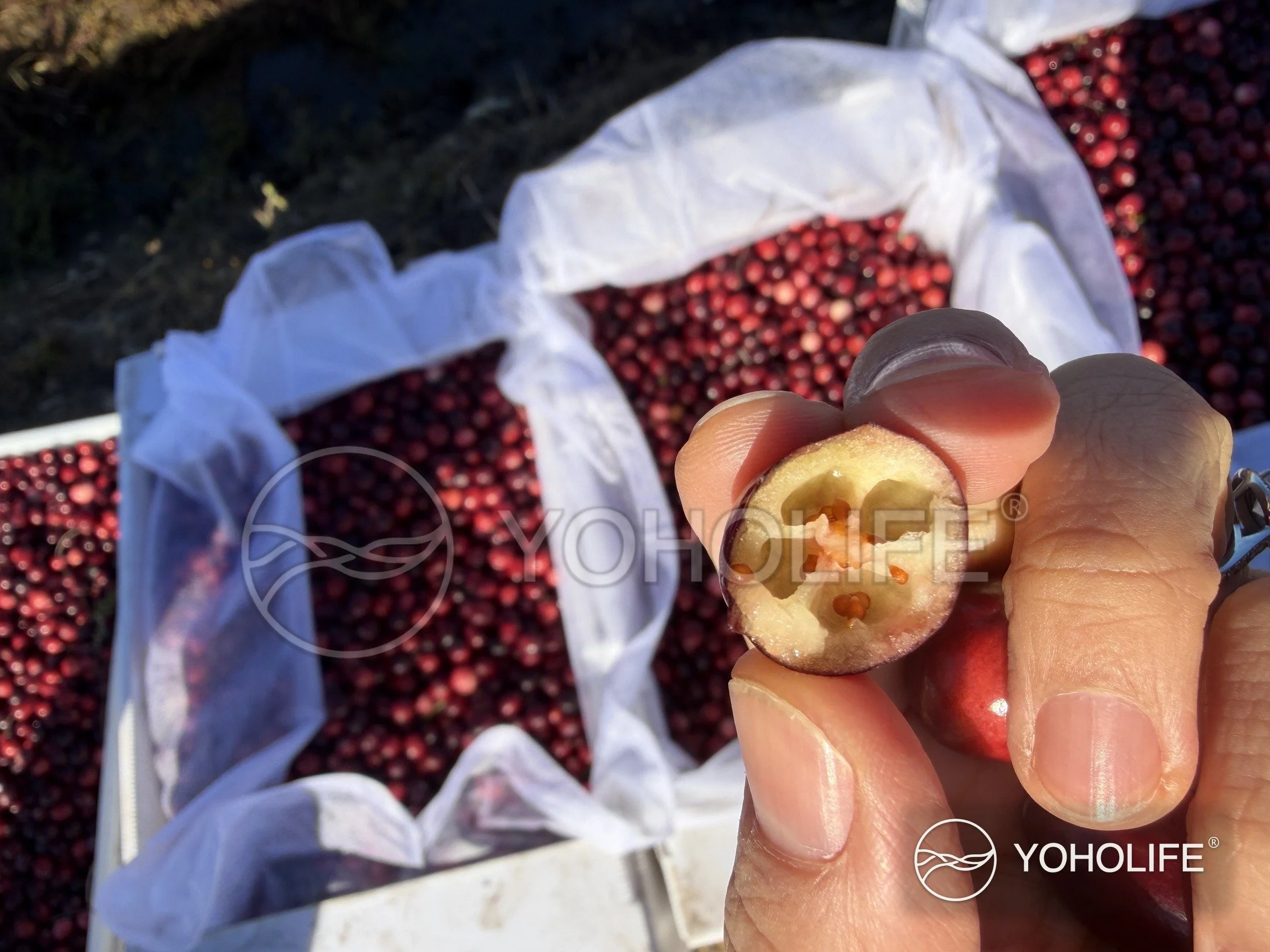
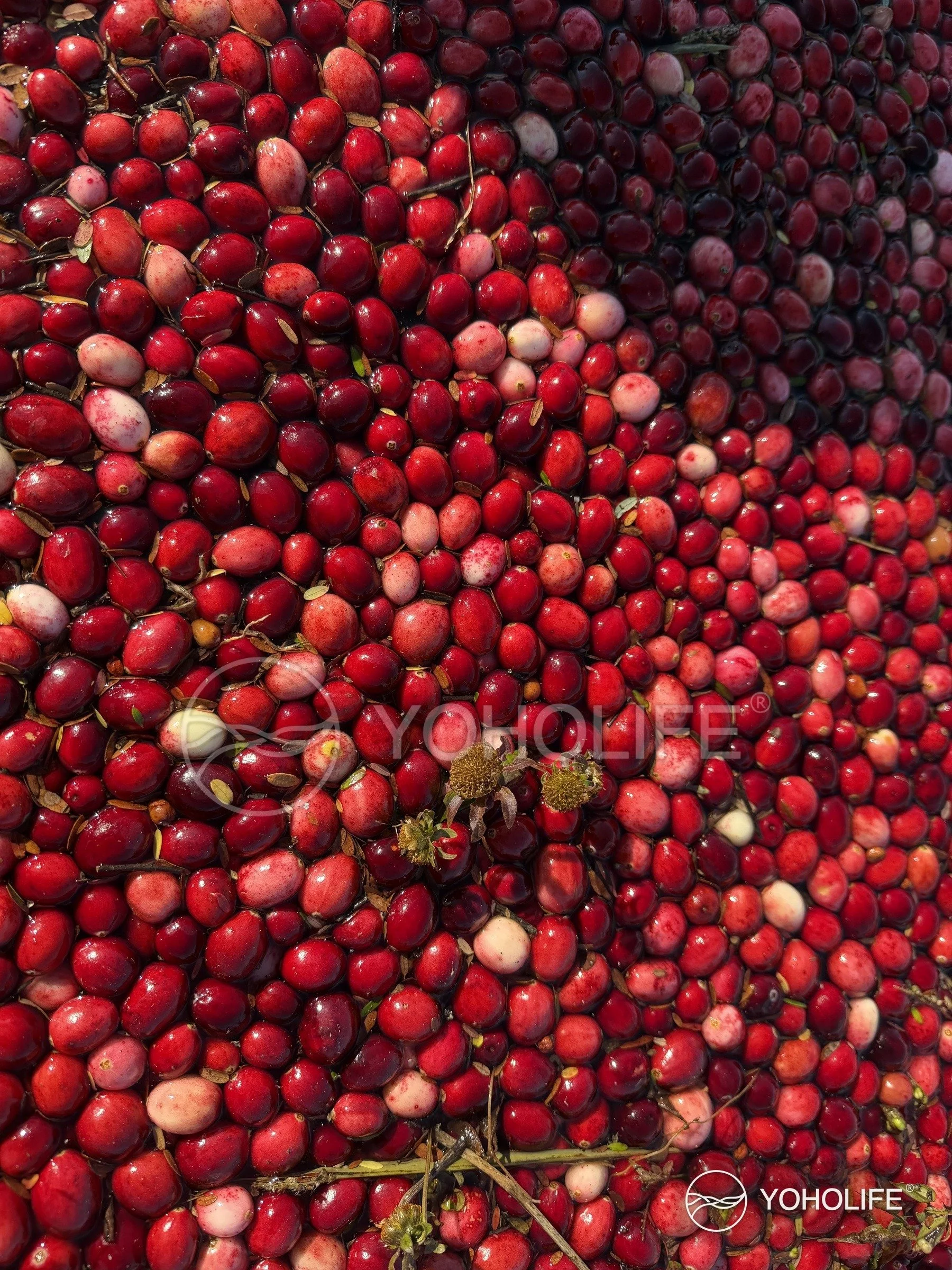
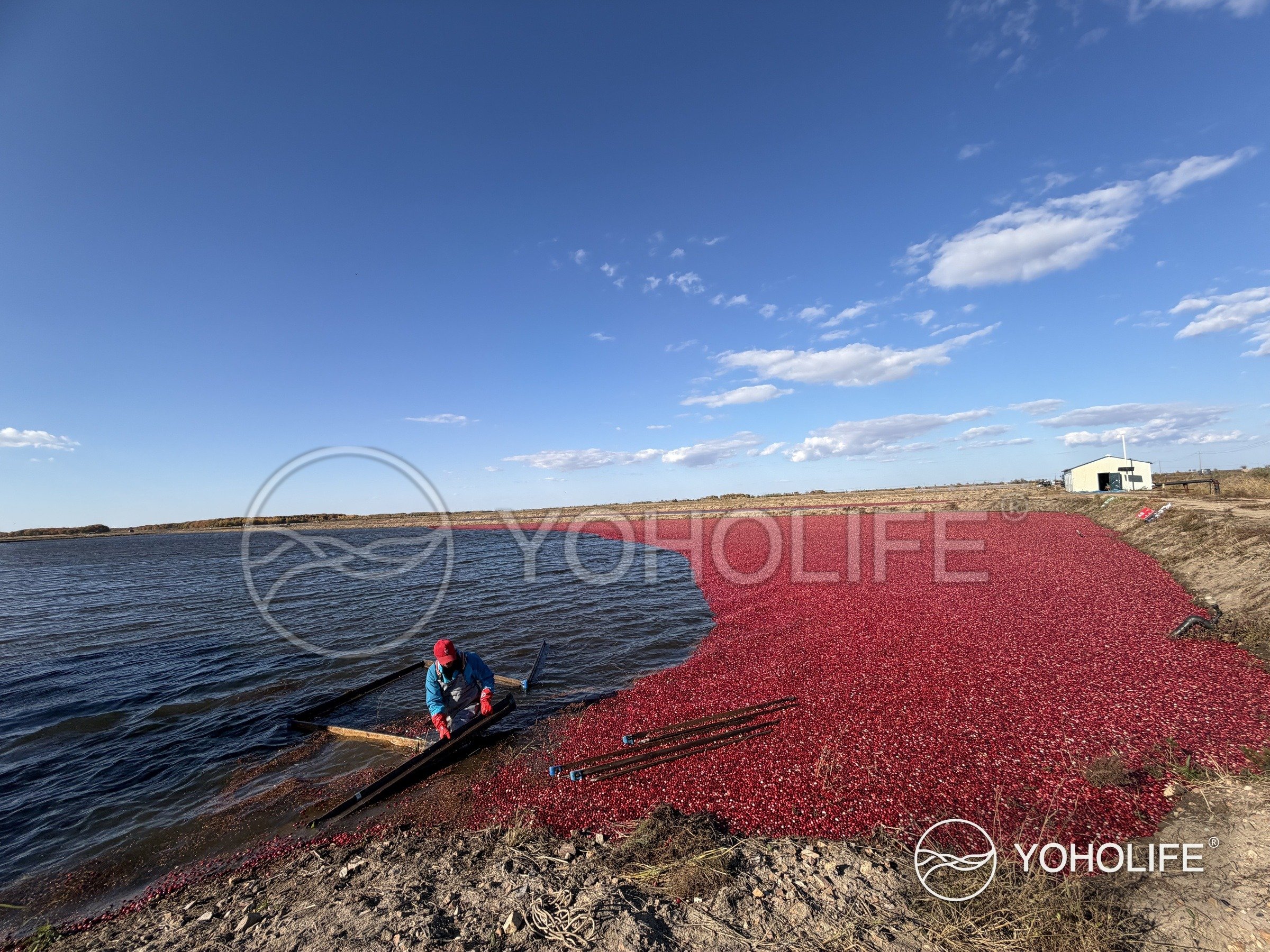
In the wet harvest, water is temporarily introduced to the growing bed. The berries are loosened from the vines and rise to the surface: air pockets within each fruit make it buoyant. Our photograph of a cut berry, held in the hand, makes those internal spaces visible. The floating berries can then be gathered and lifted out. It is the image many people associate with cranberries—a surface transformed by thousands of small red fruits.2
The dry harvest keeps the fruit on land. Harvesting equipment combs or picks the berries from the vines, and the crop is collected without flooding the bed. In our field photographs, filled crates line the track, giving the harvest a visible rhythm: plants, collection, handling, and the next load ready to move.
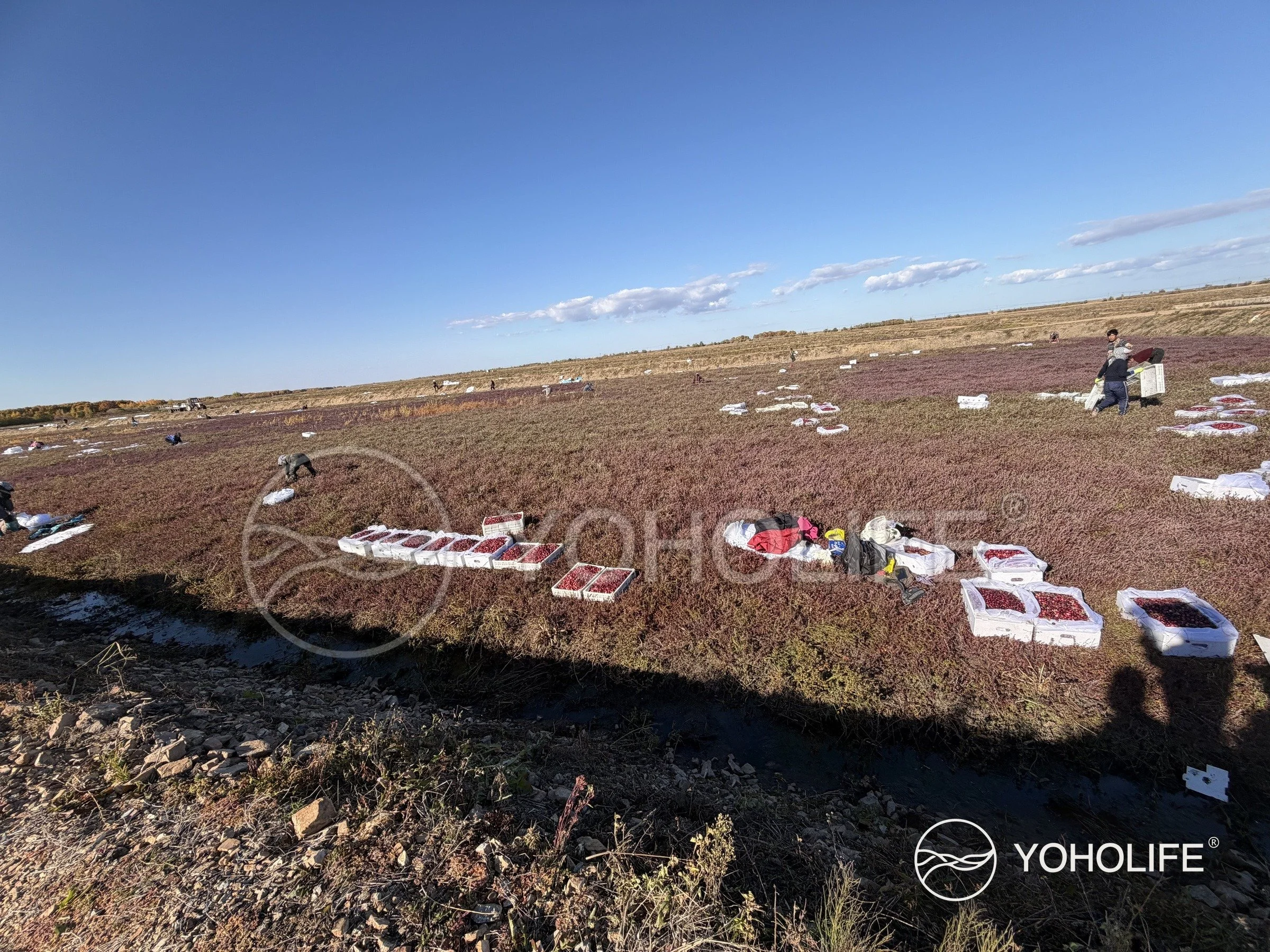
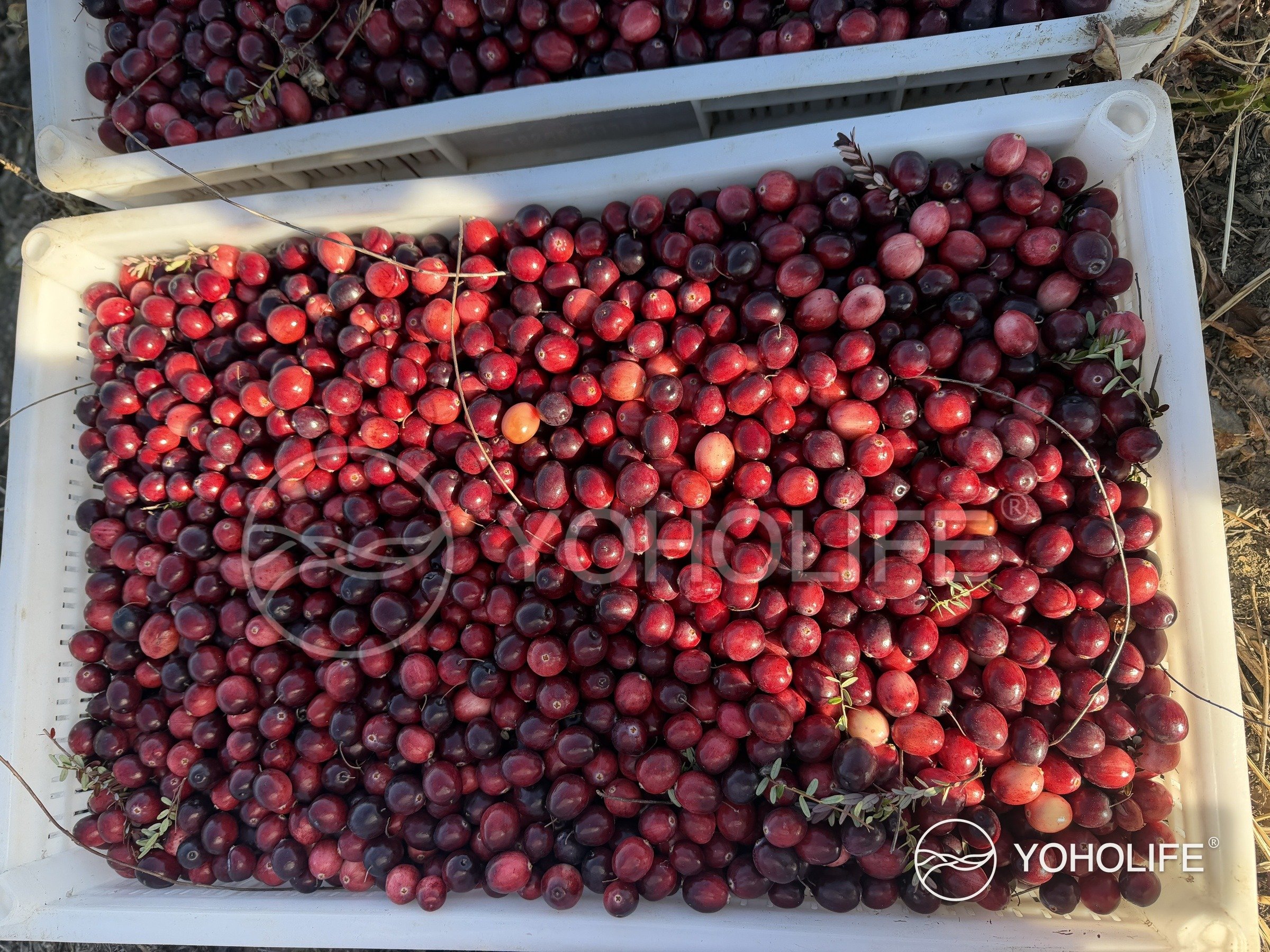
Wet-harvested cranberries are commonly used for processed products, while dry harvesting is generally associated with fruit destined for the fresh market. Neither image alone tells the whole story of a growing season. Both depend on knowing the crop, choosing the appropriate harvest process, and caring for the fruit as it leaves the field.2
Water creates a striking scene at harvest time. Cranberries themselves grow on vines in cultivated beds; they do not spend their lives growing underwater. Seeing both methods side by side brings that distinction into focus.
03 / A RELATIONSHIP AT SCALE
The people within the panorama
Four thousand two hundred mu is a substantial cultivated source. Around 3,000 tonnes a year describes the output our partner reports. Behind these figures are the recurring tasks that keep a base productive: tending established plants, organising harvests, collecting fruit and preparing it for its next stage.
Our long-standing cooperation keeps us close to this work. Visits give us an opportunity to see the harvest directly, discuss the growing and handling process with our partner, and connect the raw material to the requirements of our ingredient customers.
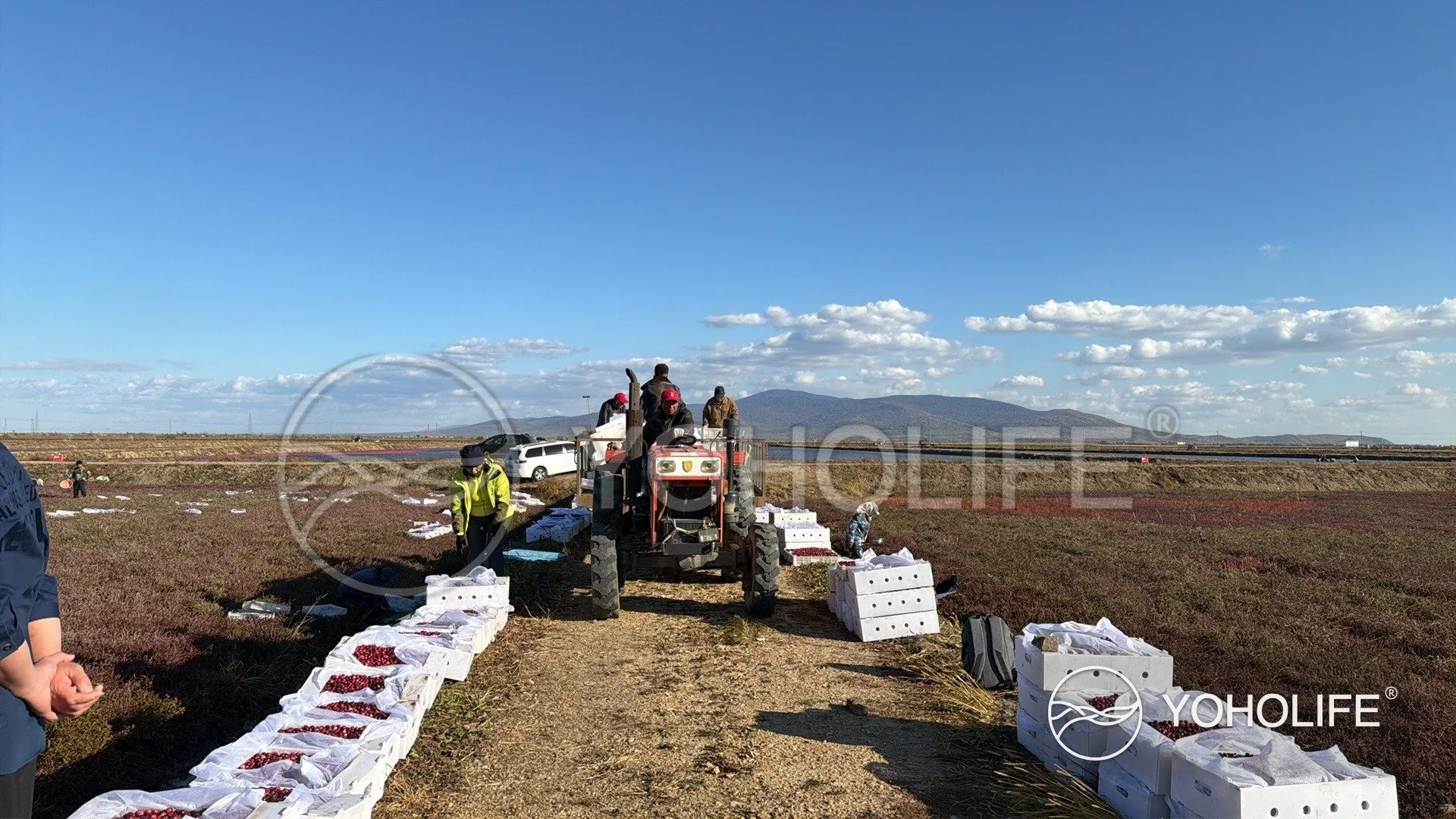
The photographs also keep the people visible. Beside the machinery and crates are those whose labour turns a crop into a harvest. Cultivation and harvesting provide employment for local farmers and workers. The scale of the base matters because it creates an ongoing setting for that work—and because a lasting supply relationship can carry value back to the community at its source.
04 / FROM FRUIT TO SPECIFICATION
What a number needs to mean
An ingredient’s journey continues beyond the field. For customers developing nutrition products, botanical identity and a clearly defined analytical specification must travel with it.
YOHOLIFE® offers a cranberry extract specified at 30% or more total soluble proanthocyanidins, measured by BL-DMAC / UV-Vis and expressed as procyanidin A2 equivalents. Procyanidin A2 is used as the reference standard, with absorbance measured at 640 nm. This is a particular company-supplied extract specification; the assay method, reference standard and expression of the result are part of what defines the figure.
A percentage becomes useful when its measurement is clear. Results obtained using different analytical methods or calibration standards are not automatically comparable. The BL-DMAC assay measures total soluble PACs without distinguishing A-type from B-type structures. Expressing the result as procyanidin A2 equivalents gives the measurement a defined reference basis; it does not establish the percentage of isolated A-type PACs.34
For YOHOLIFE®, precision belongs alongside the story of the source. The field visit tells us where the fruit begins. A transparent specification gives our customers a more meaningful basis for evaluating the ingredient and discussing the grade suited to their formulation.
05 / WHAT RETURNS TO THE SOURCE
A harvest that carries something forward
At the end of the visit, the red fruit stays in our photographs. What we want to carry forward reaches further: the cultivated plants that support future seasons, the local work behind this one, and a clearer understanding of the ingredient we bring to our customers.
For the plant: continuity through cultivation
Our partner’s work with cultivated planting material helps maintain the cranberry source for future growing seasons. Through long-standing cooperation, YOHOLIFE® supports continuity between cultivation and ingredient development. Preserving and tending productive planting material gives the next harvest a beginning; it also keeps agricultural knowledge connected to the plants it serves.
For the community: work at the source
The base provides employment through cultivation, harvesting and the handling of fruit. Our participation in this supply relationship supports work carried out where the crop is grown. Giving back has a social meaning here: allowing some of the value of a botanical ingredient to return to the people whose labour makes it possible.
For the land: care beyond a single harvest
For the land, our commitment is to make cultivation part of a long view. Soil and water are conditions of every future season. Following the source helps keep their careful management within our conversations with partners, alongside production and quality. Responsibility grows through this continuing attention, rather than being completed when the fruit is collected.
For nutrition: a foundation of clear specifications
For the people who will use products made with our ingredients, our contribution is careful development: a known botanical source, clearly described measurements and informed choices about the specification. We want the promise of a natural ingredient to rest on work that can be understood, from the cultivated plant to the technical document.
We came to Heilongjiang to see a harvest. We left with a responsibility to what follows it: another season of growth, work that remains rooted in the community, and ingredients developed with care. The most enduring value of this red fruit is what it helps us carry into the future.
What we gather is one season’s harvest. What we give back should help the next season grow.
Visit details and the described extract specification were supplied by YOHOLIFE®. Base area, annual production and the origin of the initial planting material are reported by our cultivation partner. Annual production is an approximate reported figure. Assay description: YOHOLIFE® Method of Assay — Cranberry Extract — BL-DMAC UV-Vis.
Field films
Two short, silent glimpses of the cranberry harvest in Heilongjiang: wet harvesting and dry harvesting. Both films carry the YOHOLIFE® watermarks.
Wet harvest · Heilongjiang, China · 6 October 2026. A silent field film by YOHOLIFE®; central and corner watermarks are embedded in the footage.
Dry harvest · Heilongjiang, China · 6 October 2026. A silent field film by YOHOLIFE®; central and corner watermarks are embedded in the footage.
