
Field notes from the guaraná growers we work with in Brazil
Field visit · Brazil
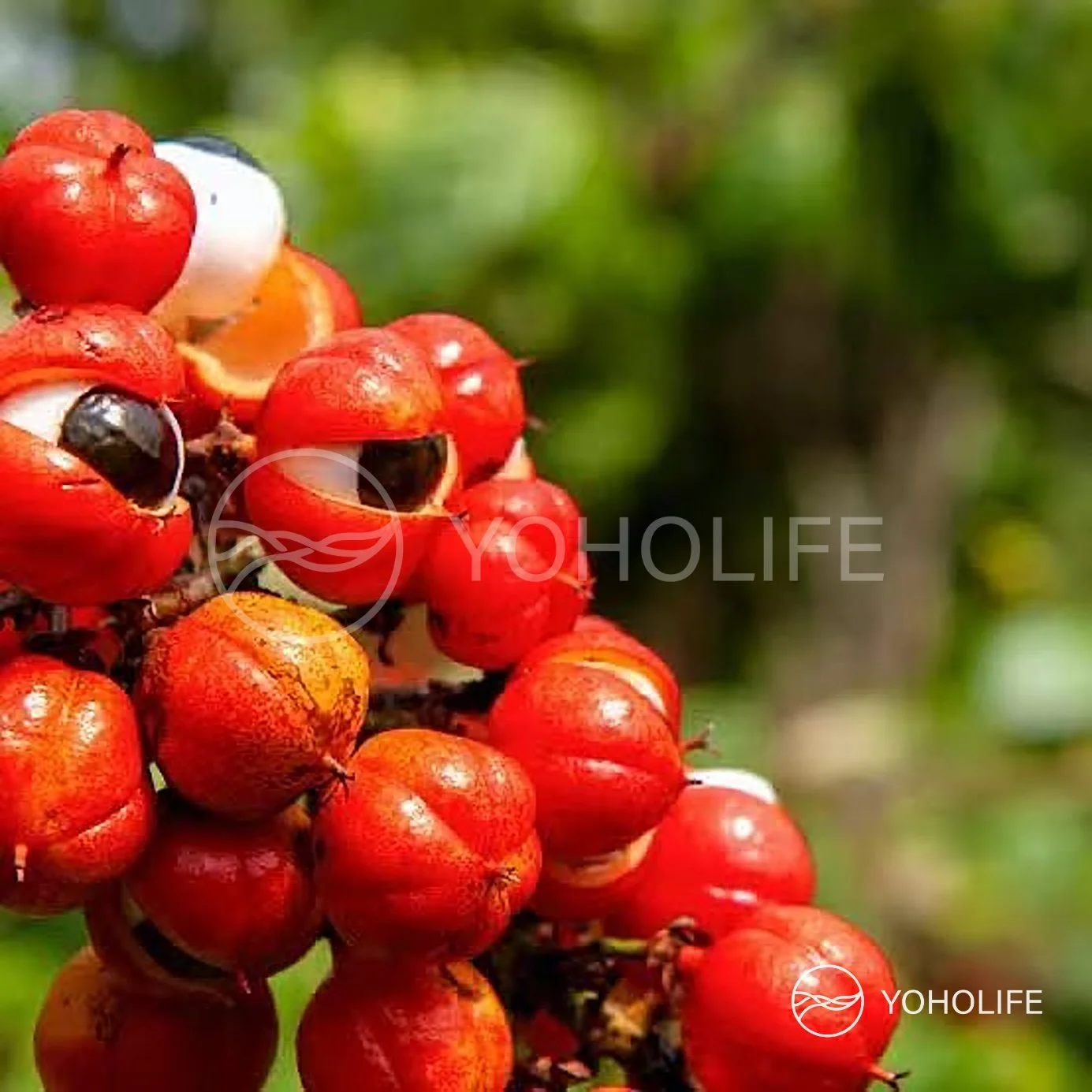
Red on the branch, then a glint of black and white: guaraná shows when it is ready.
On a visit to the guaraná growers we work with in Brazil, the YOHOLIFE® team followed a familiar ingredient back to its plant: a climber of the Amazon whose fruit splits open when it ripens, the hands that gather it, and the seed on which everything else depends.
In a specification, guaraná is often reduced to one figure: its caffeine content. In the field it is a crop with a rhythm of its own—clusters that ripen unevenly, baskets filled by hand, and seeds that are separated, washed and dried before they travel anywhere.
Our cooperation with local growers keeps us close to that beginning. Returning to the source helps us understand what each harvest asks of the people who bring it in, and what a percentage on a certificate actually stands for.
01 / THE PLANT
A climber from the Amazon
Guaraná, Paullinia cupana Kunth, belongs to the soapberry family, Sapindaceae. It is native to the Amazon region, where it grows as a scrambling shrub or woody climber.1 Grown in open fields, it takes the form of a semi-erect shrub that can be harvested by hand.2
Its fruit is a capsule that ripens to shades of orange and red. When it is ripe, it opens by itself to show one to three dark seeds, each held in a thick white aril.2 White pulp around a black seed gives an opened cluster its well-known look of small open eyes.3
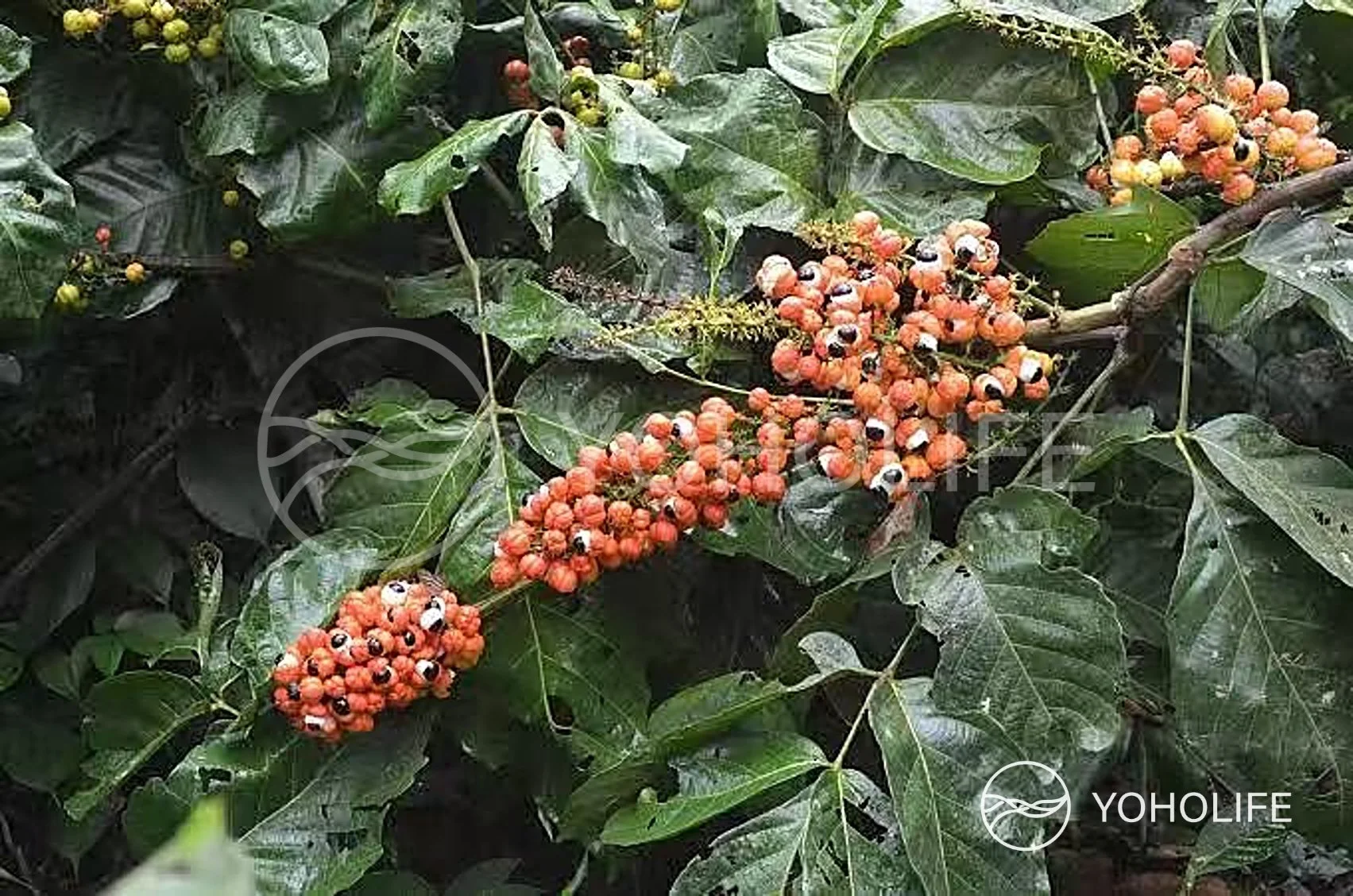
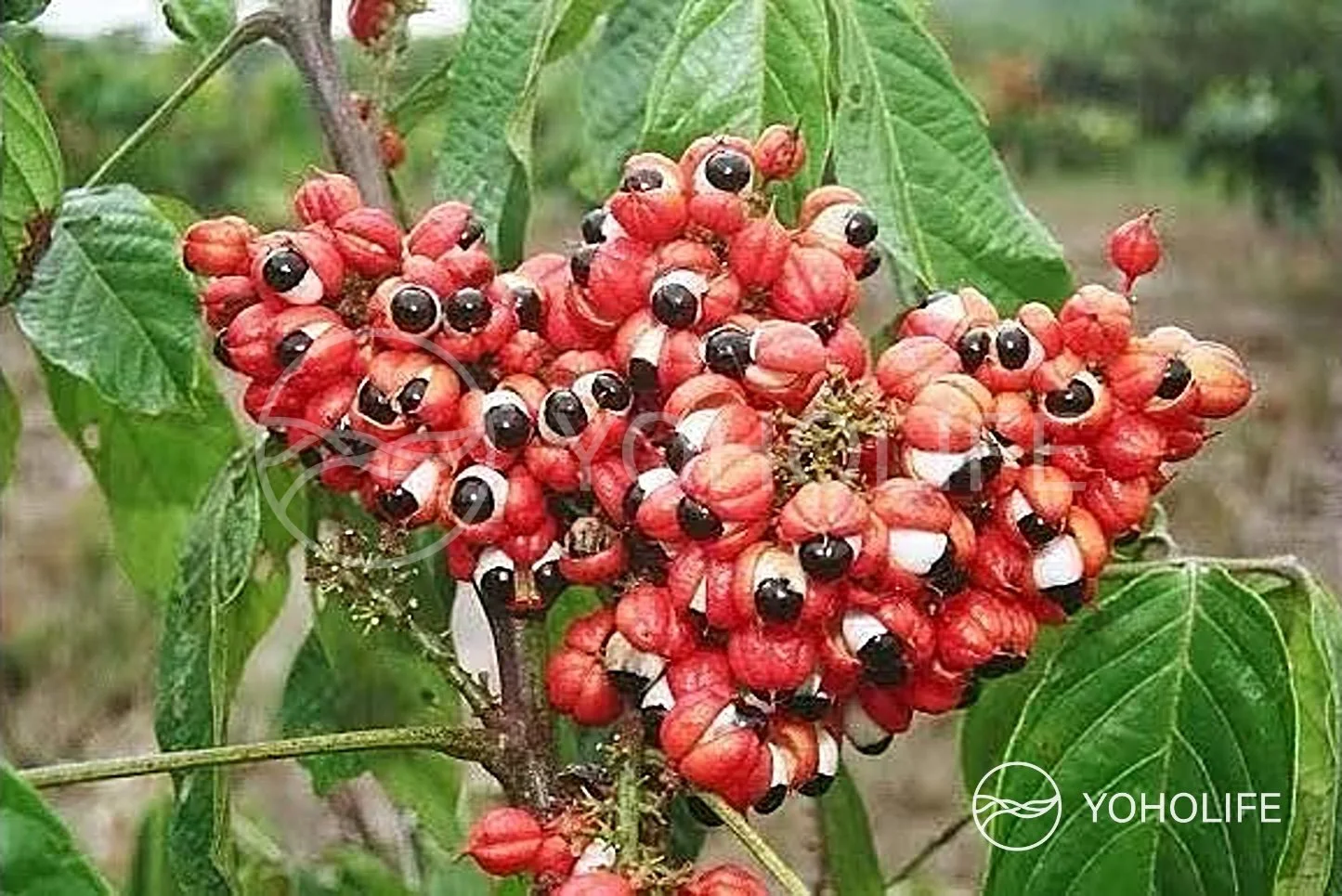
The seed is the part that matters for an extract. It carries the plant’s naturally occurring caffeine—published figures for the seed range from about 1% to almost 6%—with much smaller amounts of theobromine and theophylline, and a large share of catechins and condensed tannins.4 Brazil’s pharmacopoeia sets a minimum of 3.5% caffeine for dried guaraná seed.5
02 / THE HARVEST
Gathered by hand, cluster by cluster
Guaraná does not ripen all at once. Growers pick only the ripe, opened fruit, or take the whole cluster once more than half of it has opened, and they do it by hand.6 Our photographs from the field show that work: a picker leaning into the foliage, a woven basket on one arm, red fruit visible among the leaves.
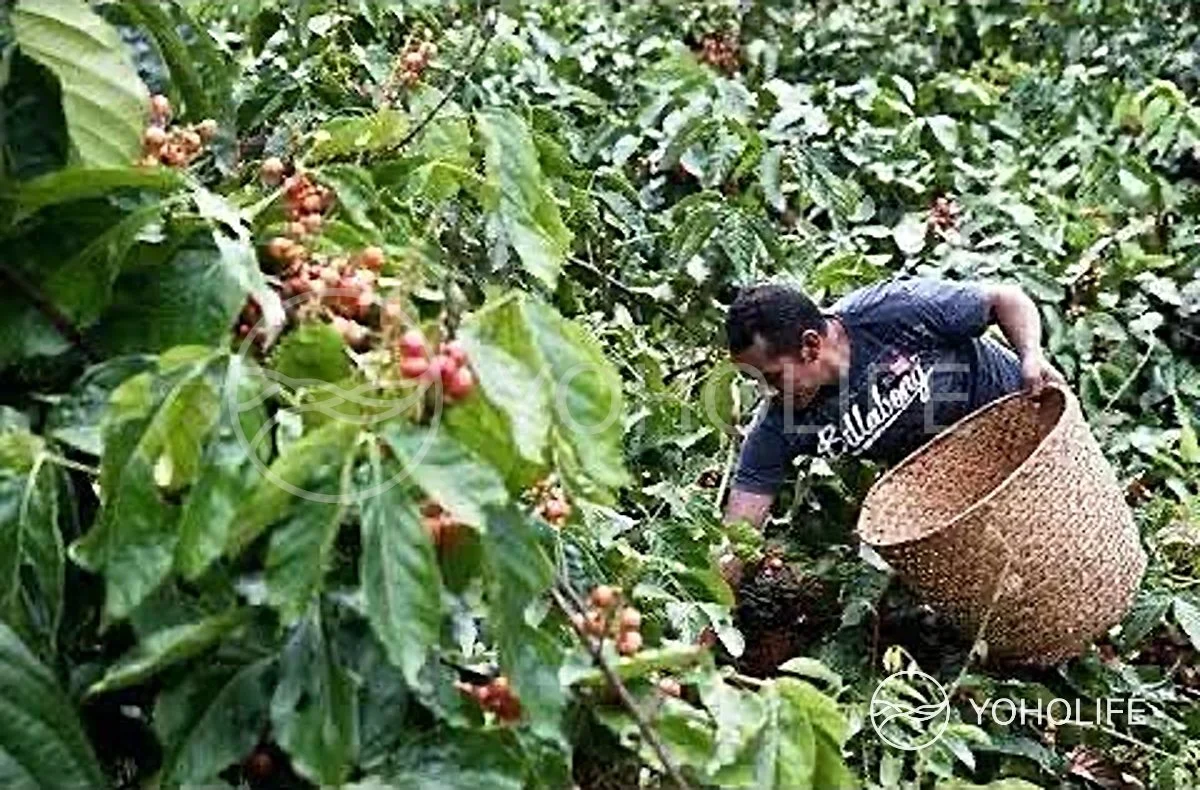
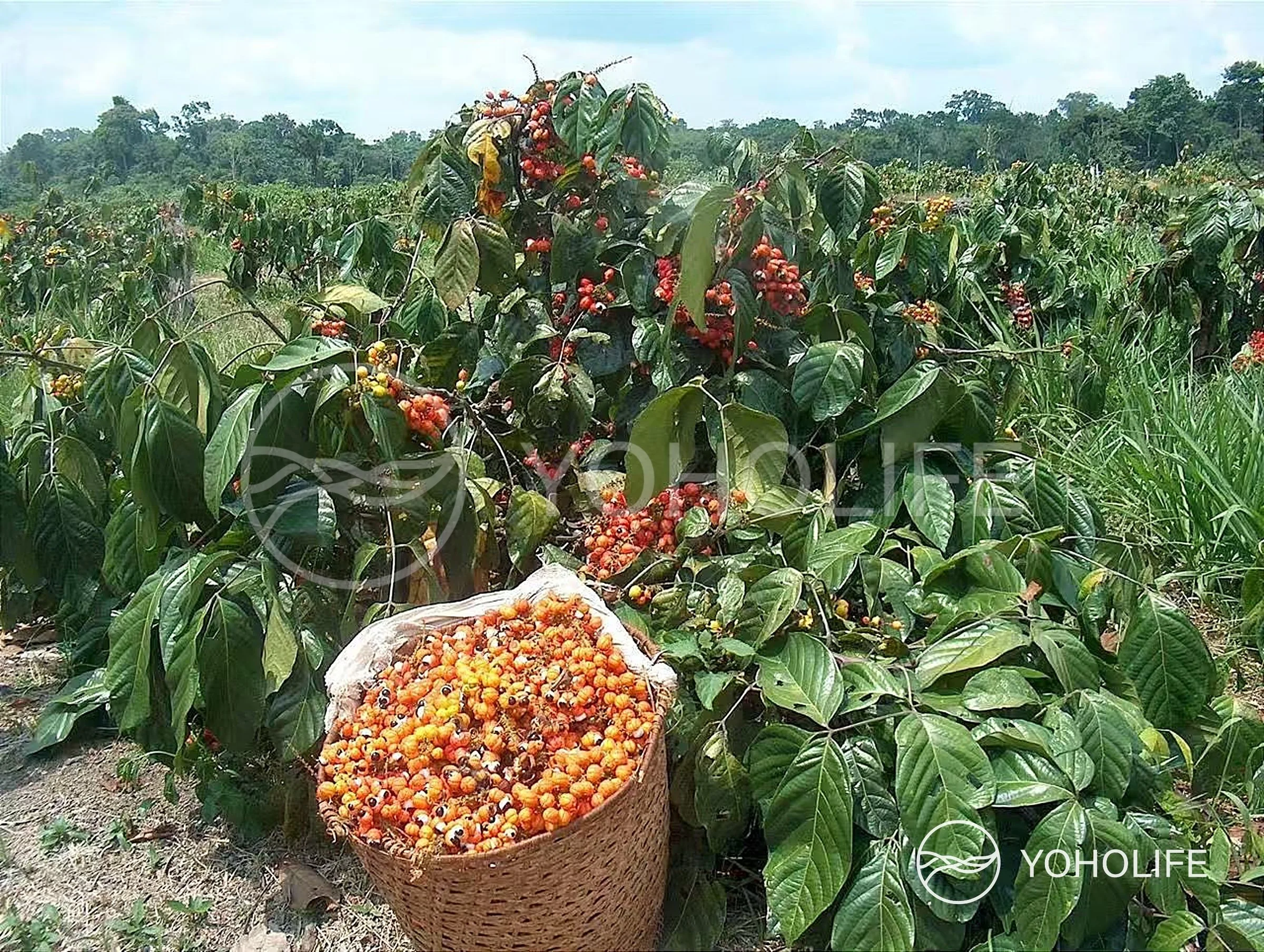
What happens next still takes place close to the field. The fruit is heaped for two to three days to ferment lightly; the seeds are then freed from the pulp, washed, and either roasted for four to five hours in clay or metal ovens or dried in the sun, to a moisture of about 10–12%.6
For us, seeing these steps is part of knowing the ingredient. Seed that has been cleaned and dried with care begins its journey in a better state, and that difference is easier to discuss with a grower than to correct later in the supply chain.
03 / WHERE IT GROWS
A Brazilian crop, from Maués to Bahia
Brazil is the only commercial producer of guaraná.3 In 2023 the country harvested 2,523 tonnes of guaraná seed. Bahia grew 68% of it, led by the municipalities of Ituberá, Taperoá, Valença and Camamu; Amazonas grew about a quarter, with Maués among its largest producers.7
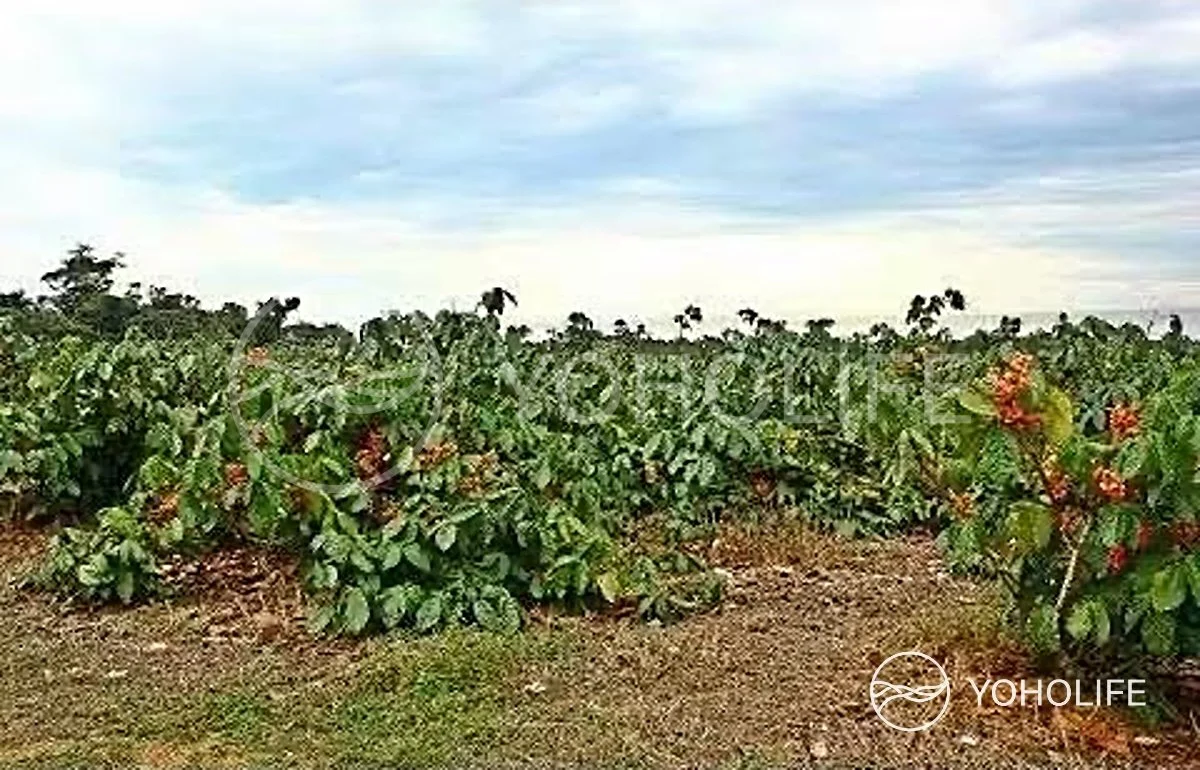
The plantations we visited are working landscapes: rows of shrubs, paths between them and forest close by. Each plant is tended and harvested individually, so the crop rewards attention more than speed.
That is also where a supply relationship starts. Knowing the growers, the plants and the timing of the harvest gives us a better basis for planning with our customers than any single shipment could.
04 / FROM SEED TO SPECIFICATION
What a caffeine figure needs to say
YOHOLIFE® offers guaraná seed extract across a caffeine range of 1% to 22%. Our featured grades are 10% and 22% caffeine. The extract dissolves well in water, which makes it practical for ready-to-drink beverages and powdered drink mixes.
A percentage is useful because it lets a formulator work backwards from a target. Supplying 80 mg of caffeine takes about 0.8 g of the 10% grade, or about 0.36 g of the 22% grade. The choice changes how much extract a recipe carries, and with it the colour, taste and cost of the finished drink.
Caffeine also shapes the label. Under EU food-information rules, a drink containing more than 150 mg of caffeine per litre must carry the statement “High caffeine content. Not recommended for children or pregnant or breast-feeding women” and give the caffeine content per 100 ml; tea and coffee drinks named as such are exempt.8
Brazil’s pharmacopoeia measures caffeine in guaraná seed by HPLC with UV detection.5 When you compare offers, ask which method the certificate of analysis uses. Our article on why UV and HPLC assay figures differ explains why the method matters as much as the number.
05 / WHAT RETURNS TO THE SOURCE
A harvest that carries something forward
At the end of the visit, the red of the fruit stays in our photographs. What we want to carry forward is less visible: the plants that will fruit again next season, the local work behind this one, and a clearer understanding of the ingredient we bring to our customers.
For the plant: a crop that returns each season
Guaraná is a perennial crop. The same plants are tended and harvested year after year. We see our cooperation with local growers as part of that continuity, not as a single purchase.
For the growers: work that stays at the source
Picking guaraná is careful, manual work. Working with local growers keeps part of the value of a botanical ingredient with the people whose labour brings it in.
For the land: cultivation with a long view
The crop grows beside the forest it came from. Following the source keeps soil, water and the surrounding landscape part of our conversations with growers, alongside quality and supply.
For our customers: a clear specification
For the formulators who use our ingredients, our contribution is a known botanical source, a clearly stated caffeine grade and documents that explain how it was measured.
We went to Brazil to see where guaraná begins. We came back with a clearer sense of what follows from it: another season on the same plants, work that stays rooted where the crop grows, and an ingredient described as carefully as it was gathered. Our companion field note on acerola follows a very different fruit from the same journey.
The seed travels far from the branch. What it is worth should stay close to the people who grow it.
Visit details and the described extract grades were supplied by YOHOLIFE®. Production figures are IBGE crop-survey data for 2023 (source 7). The photographs were taken by YOHOLIFE® in Brazil; older images were cropped and sharpened for the web, without redrawing anything.
